
CASE STUDIES
Check out these real life SMS texting success stories
More people send and receive text messages than use the mobile web or any other mobile application besides phone calling. Researchers say that over 10 TRILLION text messages were sent in 2012. Click on the tabs below to read success stories.
Papa John's delivers big gains with text ordering system
Summarized from “Mobile Marketing 101”
By Mitchell Cogert ©2011
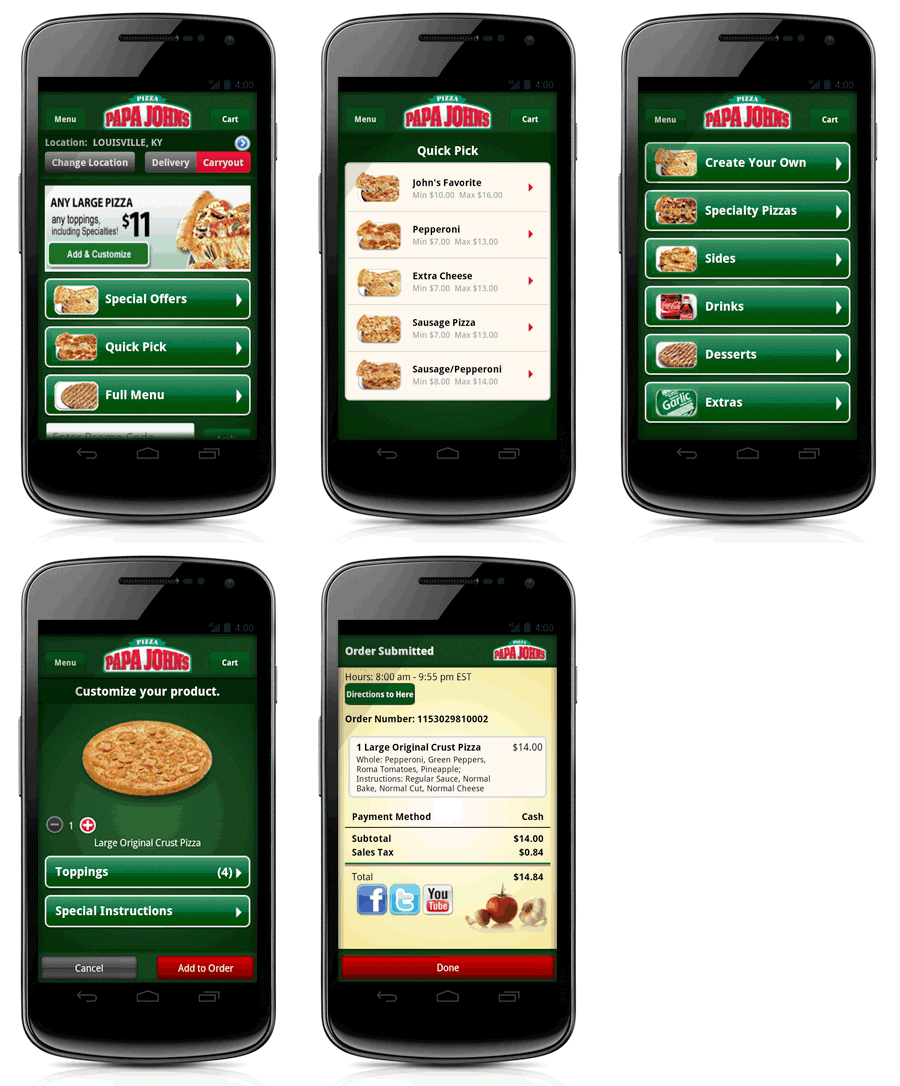 Papa John’s is one the most prolific users of text messaging campaigns in the restaurant industry. They developed a texting campaign that allows users to order pizza via text message. The campaign reportedly brought in an additional $1 million in revenue within six months of implementation.
Here’s the process:
- Customers register online at www.papajohns.com and save their favorite orders, delivery and payment preferences with the Papa John's "Favorites Wizard."
- Once registered online, the Papa John's consumer can simply text FAV1, FAV2, and so forth, to 4PAPA (47272).
- Papa John's then sends a text message detailing the order and requesting confirmation from the consumer.
- The consumer presses Y1 to confirm the order for FAV1 or N1 to change the order. Once confirmed, the closest Papa John’s restaurant processes the order.
Today, about 20% of the pizza chain’s sales come from mobile, SMS and smartphones. By allowing its customers to order via text message from their cell phones, Papa John’s is not only saving itself money and time (spent on the phone with customers taking orders, for example), but it’s also building a mobile database of loyal customers who are open to receiving coupons, special offers and exclusive savings now and in the future via text messaging.
Starbucks brews up exposure with quiz, scavenger hunt
Summarized from “Mobile Marketing 101”
By Mitchell Cogert ©2011
Starbucks set up a “Summer Pursuit” text messaging campaign. It was a trivia quiz that customers participated in by answering three questions, all related to a summer theme.
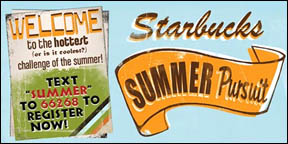 The questions were sent to the customers’ cell phones, and those recipients who answered correctly got the opportunity to play Starbucks’ “Ultimate Scavenger Hunt” in New York City or Costa Rica. To play the "Starbucks Summer Pursuit," customers texted the message "SUMMER" to 66268. Within seconds, players received text clues on their mobile phone.
The game challenged participants to decipher a series of text message clues. Players were challenged to answer summer and Starbucks-related trivia questions and then submit them via a mobile phone in the form of a picture or text message. It was the first mobile scavenger hunt incorporating visual recognition technology to determine whether submitted images represent the correct answer to each question, and also send additional clues to create an ongoing, interactive experience with each player.
The five-week trivia contest/virtual scavenger hunt culminated in a real-time finale in New York City for five lucky contestants (and their guests) chosen at random from those who had registered online. The hunt for the final clues in the city rewarded the winner (and guest/teammate) with a trip to Costa Rica, one of the world's largest coffee-producing countries.
Thousands climb aboard
Subway mobile coupon program
Summarized from “Mobile Marketing 101”
By Mitchell Cogert ©2011
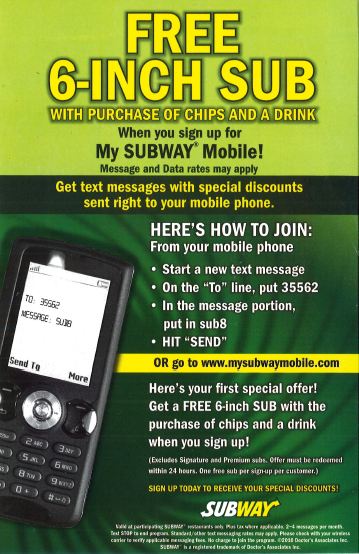
A Subway franchise came up with a “My Subway Mobile” program. The campaign was advertised via brochures, on radio and television stations in the restaurant’s local market area.
Special product offers and coupons that could only be accessed via text message or email drew customers in, urging them to sign up for the promotion. Each message included an alphanumeric code that the customer could present to the Subway cashier for a free sandwich and a drink when making a purchase. Expiration dates were instituted for each code, with three to four of them being sent out monthly to customers.
The franchisee who came up with the campaign reported that 5,000 customers signed up for the promotion, and that the 10,000-plus text messages that were sent out translated into a nearly 9% redemption rate. According to the company, SMS alerts sent out to the 5,000-plus recipients typically results in “near instant customer traffic.” The campaign has since been expanded to other Subway franchises.